
The Gateway Arch is one of America’s most recognizable landmarks, but how much do you actually know about it? You probably know it’s in St. Louis, and you’ve likely seen the iconic photos. But there’s a lot more to this unusual monument than meets the eye.
Whether you’re planning a trip to St. Louis, curious about the history and design of the Arch, or simply wondering if it’s worth visiting, here are some fun, surprising, and downright unusual facts about the Gateway Arch that might make you appreciate it a little more.
The Gateway Arch is the tallest arch in the world!

The iconic Gateway Arch in St. Louis is the tallest arch in the world, rising an impressive 630 feet above the ground! And here’s an even more surprising fact, the Arch is also exactly 630 feet wide at its base.
For some perspective, the Eiffel Tower in Paris stands about 984 feet tall, making it considerably taller than the Gateway Arch. But while the Arch may not be the tallest structure in the world, its unusual proportions and graceful curved design make it one of the most recognizable landmarks in America.
You can actually ride to the top of the Gateway Arch
One of the coolest things about the Gateway Arch is that you don’t just look at it from the ground, you can actually take a ride inside it all the way to the top!
If you imagine riding in a normal elevator, think again. The Arch has a unique tram system made up of small five-person cars that travel along the curved interior of the Arch, tilting as they make their way upward.
You’ll travel 63 stories to the observation area at the top, where small windows offer incredible views over St. Louis. Once you reach the top, your time in the observation area is limited to about 10 minutes, but that’s plenty of time to take in the views and snap a few photos.
The tram cars are tiny, so if you’re claustrophobic, you may want to think twice about riding to the top. If you are claustrophobic or afraid of heights, but still curious about what the tram ride is like, you can get a feel for what it’s like without actually going up inside a full-scale replica of a tram car which you can find near the ticket center.
You can see two states from the top

On a clear day, you can see up to 30 miles in either direction from the top of the Gateway Arch! The Arch sits right along the Mississippi River, with St. Louis on the Missouri side and Illinois directly across the river.
From the observation area, you can look out over downtown St. Louis in one direction, and across the Mississippi River into Illinois from the other.
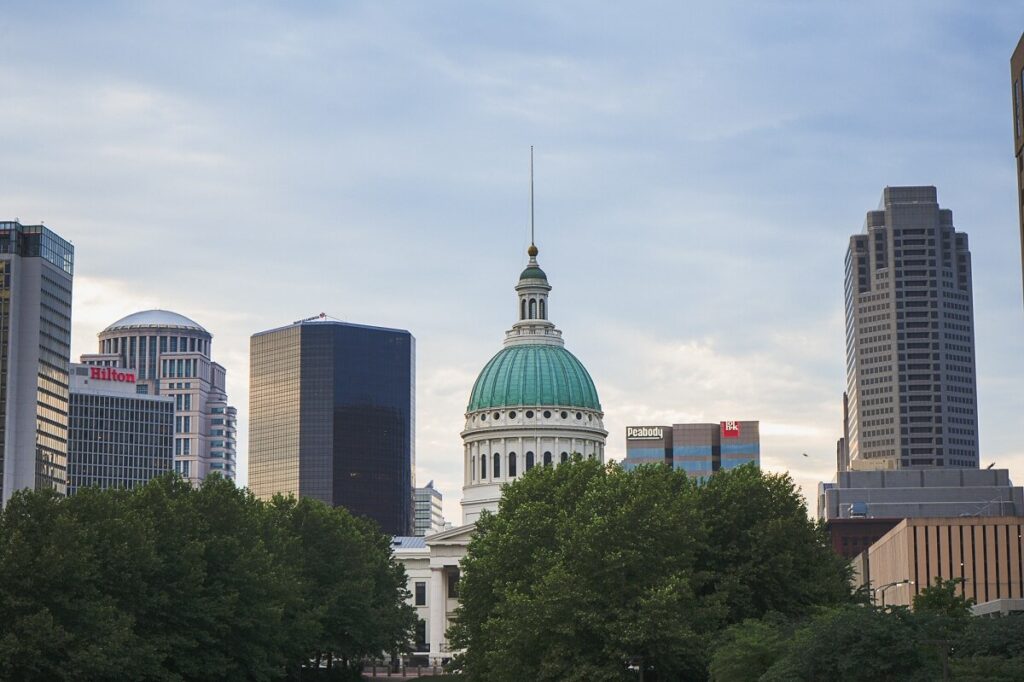
On the Missouri side, you can spot Busch Stadium, the Old Courthouse, the Mississippi River and the surrounding St. Louis skyline from the tiny windows at the top.
It is designed as an inverted catenary curve

There’s a reason the Gateway Arch has such a distinctive shape. Architect Eero Saarinen based the design on an inverted catenary curve. Don’t know what that is? It’s basically the shape formed by a chain when it’s hanging freely between two points. Turned upside down.
That’s what gives the Arch its graceful, almost effortless appearance, even though the engineering behind it is anything but simple.
The Arch is covered in stainless steel, which gives it its distinctive silvery appearance. It was built using a colossal 142 stainless-steel sections containing almost 900 tons of stainless steel. More than had ever been used for a single project at the time!
The Gateway Arch actually moves

Okay, so maybe the tram ride didn’t scare you off with its tiny, claustrophobic capsules and 63-story ascent. But what if I told you the Arch was designed to move?
Yep! Although it was designed to withstand extreme weather such as high winds and earthquakes, this massive stainless-steel structure will sway under certain conditions. In fact, the Arch can sway as much as 18 inches under extreme conditions.
But don’t worry, it’s highly unlikely you’ll see the monument rocking back and forth over St. Louis. That is, of course, unless winds of around 50 miles per hour come whipping through the city.
Still, knowing you’re standing 630 feet above the ground inside a structure that can sway a little certainly gives you something else to think about.
It has been the site of some wild stunts

Unfortunately, the Gateway Arch has been the site of some pretty wild stunts over the years, some that have ended tragically.
The Arch’s incredible height and unusual design have attracted thrill-seekers determined to get to the top by unconventional means, despite laws prohibiting people from climbing or jumping from the structure.
In 1980, daredevil Kenneth Swyers attempted to parachute onto the top of the Arch after jumping from an airplane. Tragically, his parachute failed to open as planned, and he fell to his death.
Then, in 1992, base jumper John Vincent managed to climb to the top of the Arch using suction cups before parachuting back to the ground. He was subsequently sentenced to three months in federal prison for the stunt.
Thankfully, you don’t need to break any laws or risk your life to experience the top of the Arch because the perfectly legal tram ride will get you there!
The Gateway Arch didn’t become a national park until 2018

Despite being one of America’s most recognizable landmarks, the Gateway Arch is a surprisingly recent addition to the National Park System.
The Arch was completed in 1965 and was originally designated as the Jefferson National Expansion Memorial. It remained a national memorial for more than 50 years before being redesignated as Gateway Arch National Park in 2018.
So if you remember visiting the “Gateway Arch National Memorial,” you’re not imagining things, the name really did change!
Today, Gateway Arch National Park encompasses much more than the Arch itself. It includes the surrounding grounds, the Museum at the Gateway Arch and the historic Old Courthouse.