
Nestled in the heart of Glacier National Park, the Avalanche Lake Trail is one of the park’s most scenic and accessible hikes. This moderate trail winds through a lush cedar and hemlock forest, following Avalanche Creek before opening up to the breathtaking sight of Avalanche Lake, framed by towering cliffs and cascading waterfalls. In this guide, you’ll find everything you need to know before hitting the trail, from how to get there to the best time to visit.

The Avalanche Lake Trail is one of Glacier National Park’s most popular hikes, offering a rewarding journey through old-growth forest to a stunning alpine lake. The hike begins along the Trail of the Cedars, a short, accessible loop that showcases towering western red cedars and hemlocks.
From there, the trail follows Avalanche Creek, where hikers can admire the rushing turquoise water carving through a narrow, moss-covered gorge. The trail gradually climbs about 500 feet over 2.3 miles (one way), making it a moderate and manageable hike for most visitors.

Along the way, hikers will pass through dense forest, cross wooden footbridges, and enjoy occasional mountain views before arriving at Avalanche Lake, a breathtaking glacial lake surrounded by sheer cliffs and multiple waterfalls cascading down from Sperry Glacier.
The round-trip hike covers 4.6 miles and typically takes 2 to 3 hours, though many hikers choose to linger at the lake’s shoreline to soak in the views. The trail is well-maintained and not overly steep, making it a great choice for families, beginner hikers, and those looking for a rewarding but not overly strenuous adventure in Glacier National Park.

Trail Details
- Distance: 4.6 miles return
- Elevation Gain: 500 feet
- Difficulty: moderate
- Length of Time: 3-4 hours
- Restrooms: yes
- Water: yes
- Dogs: not allowed
Best time to hike the Avalanche Lake Trail
The best time to hike the Avalanche Lake Trail is late June through early October when the trail is mostly free of snow, and the lake is at its most scenic.
Spring and early summer bring rushing waterfalls and vibrant greenery, while mid-to-late summer offers warmer temperatures and clearer skies, making for ideal hiking conditions.
Fall (September – early October) is another fantastic time to visit, as the crowds thin out and the surrounding forest takes on beautiful autumn hues. However, weather conditions can be unpredictable, with cooler temperatures and a chance of early snowfall.
Winter and early spring bring heavy snowfall to the area, making the trail difficult to access. While the lower portion of the hike along Trail of the Cedars can still be explored, the full trail to Avalanche Lake is not typically recommended unless you have experience with snowshoeing or winter hiking.
How to hike the Avalanche Lake Trail

The hike to Avalanche Lake begins along the Trail of the Cedars, a short and incredibly scenic loop that’s one of Glacier National Park’s most popular trails. This means you’ll be checking off two must-do hikes in one!
The Trail of the Cedars is an easy, mostly flat path that consists of both a gravel section and a raised boardwalk, allowing visitors to admire the towering Pacific Northwest cedars that dominate the landscape. Along the way, interpretive signs provide insight into the area’s unique ecology.
 Trail of the Cedars
 Turn off for Avalanche Lake Trail
About 0.5 miles into the loop, you’ll reach the official Avalanche Lake Trailhead, clearly marked with a posted sign—you can’t miss it!
From here, the trail immediately begins with a short but steep climb, featuring rocky steps that will get your legs burning right away.
Luckily, this strenuous section doesn’t last long, and soon you’ll be rewarded with a breathtaking view of Avalanche Creek, where icy blue water rushes through a narrow slot canyon. It’s a perfect spot to pause, take in the scenery, and snap some photos.

Beyond this point, the trail follows a steady incline for 2.3 miles, winding through lush forest with occasional short descents that mix up the elevation gain.
While the hike isn’t overly difficult, you’ll likely work up a sweat—especially if it’s your first hike of the trip! Even as frequent hikers, we found ourselves needing to take a few breathers along the way.

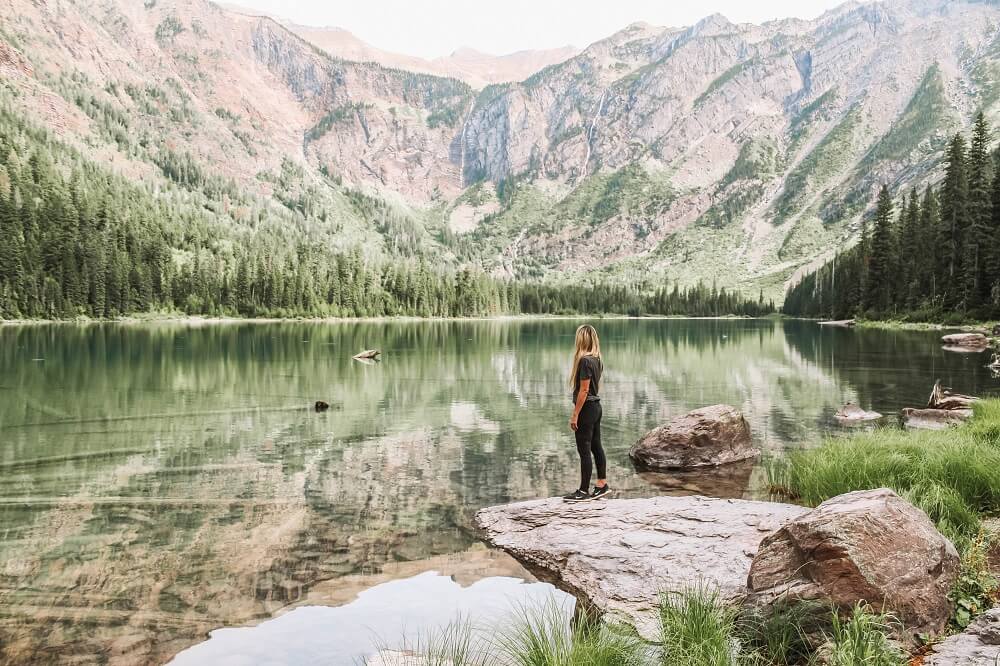
But trust us—it’s all worth it when Avalanche Lake finally comes into view. The emerald-green water, backed by towering cliffs and cascading waterfalls, creates an almost surreal scene.
Bearhat Mountain (8,694 feet) looms over the lake, and during spring and early summer, glacial runoff from Sperry Glacier sends multiple waterfalls tumbling down from its slopes.

Upon reaching Avalanche Lake, you’ll find hundreds of downed trees piled on top of each other, a result of previous avalanches that thundered down the cliffsides of Mt. Cannon. You can stop and explore these downed trees for a minute like we did.
The downed trees do not mark the end of the trail, so keep hiking a little bit further. A short distance away along the lake’s shoreline is a wide beach area with plenty of space to sit and relax. This is the best spot to soak in the magnificent scenery.

There’s also a few bench seats here that are tucked beneath trees for hikers seeking respite from the sun—though they tend to get taken quickly.
While most hikers choose to end their hike at this main viewpoint, you can explore further by continuing alongside the lake’s western shoreline all the way to the head of Avalanche Lake.

Hiking beyond the main viewpoint offers a different perspective on the landscape, as well as a little more solitude. We chose to venture further, and took the opportunity to take photos at different locations along the lake.

As you can see in our photos, very few people choose to hike past the main beach area. It was a serene experience having this section of the lake all to ourselves.


Since we had packed our fly-fishing gear, we decided to spend a couple of hours casting from a large rock jutting into the lake, and also back at the log jam area. It was a fun way to pass the time and enjoy the scenery a little longer.

Note that Avalanche Lake isn’t exactly a prime fishing destination because its nutrient-poor waters don’t support a large insect population, meaning fewer fish. Despite this, we managed to catch a couple of small Westslope cutthroat trout before calling it a day.

By the time we started our return hike, most of the crowds had cleared, and we were among the last people heading back down—a common theme for us!


The descent was much quicker, and before long, we were back at the trailhead. Since we were camping at Apgar Campground, it was a short drive back to our site, where we wrapped up the day with a warm shower and a cozy evening in our van.
Avalanche Lake Trail is an unforgettable hike that doesn’t require an all-day commitment. If you’re looking for a rewarding adventure in Glacier National Park, this trail is a must!
Tips for hiking the Avalanche Lake Trail
- Arrive Early or Hike Late – The Avalanche Lake Trail is one of the most popular hikes in Glacier National Park, and the parking lot at Avalanche Creek fills up quickly, especially in peak summer months. Arriving before 8 AM or later in the afternoon will give you the best chance of finding a spot and enjoying a quieter hike.
- Take the Free Shuttle – If parking is full, consider using Glacier’s free shuttle service, which stops at Avalanche Creek and can save you the hassle of circling for a spot.
- Be Prepared for Some Inclines – While the trail isn’t overly difficult, the first section has a short but steep climb with rocky steps. After that, the trail continues with a steady incline, so expect to get your heart rate up at times.
- Wear Sturdy Hiking Shoes – The trail is well-maintained, but there are rocky sections, some uneven terrain, and muddy spots after rain. Waterproof hiking shoes or trail runners with good grip are best.
- Plan for 3-4 Hours – While the hike itself takes about 2-3 hours, many hikers spend extra time at the lake taking in the views. If you plan on relaxing, budget at least 3-4 hours total.
- Pack Plenty of Water and Snacks – Even though this isn’t a long hike, the moderate incline and elevation can be tiring, especially on warm summer days. A hydration pack or at least 1-2 liters of water per person is recommended.
- Bring Bear Spray – Like all hikes in Glacier National Park, bear spray is a must. While encounters are rare on this trail, it’s always better to be prepared. Make noise while hiking to alert wildlife of your presence.
- Explore Beyond the Main Viewpoint – Most hikers stop at the first beach-like shoreline of Avalanche Lake, but if you have time, continue further along the shoreline or to the far end of the lake for a quieter, more secluded spot.
- Don’t Forget a Camera! – Between the Trail of the Cedars, Avalanche Gorge, and Avalanche Lake, this is one of Glacier’s most photogenic hikes. Whether you have a DSLR, GoPro, or just your phone, you’ll want to capture the breathtaking scenery along the way.
- Check the Weather Forecast – Glacier’s weather can be unpredictable, with sudden afternoon thunderstorms in summer and chilly conditions in fall and early morning. Layer up and bring a rain jacket just in case.

How to get to the Avalanche Lake Trailhead by car:
The Avalanche Lake Trailhead is located along Going-to-the-Sun Road in West Glacier, approximately 15 miles from the Apgar Visitor Center. After entering Glacier National Park, follow the road past Lake McDonald, continuing along its shoreline until you reach the Avalanche area. Keep an eye out for a sign marking the Avalanche Lake Trailhead—the trailhead will be on your right, and parking is on the left.
Parking is extremely limited, and spaces fill up quickly, especially during peak summer months. Rangers strictly enforce parking regulations, so avoid squeezing into non-designated spots because you WILL get fined.
If the lot is full, circle back a few times to see if anyone is leaving. Your best chance of getting a spot is to either arrive very early or between 12pm and 1pm when all the morning hikers are leaving.
If you’re patient and persistent, you will get a park. However, if you’re on a tight schedule and nervous about the possibility of spending too much time waiting, you can always catch the park’s free shuttle bus from the Visitor Center.
How to get to the Avalanche Lake Trailhead by bus:
Glacier National Park offers a free shuttle bus service from Apgar Visitor Center to the Avalanche Lake Trailhead. Shuttles run every 30 minutes, with an estimated 45-minute travel time to the trailhead.
These 28-passenger buses can fill up quickly during peak season, so arrive early to increase your chances of getting a spot on the first available bus. Long lines are common, especially in the morning.
The shuttle bus operates daily from 7 AM to 7 PM throughout the summer, beginning when Going-to-the-Sun Road opens and running through Labor Day. A reduced service continues into late September, so check the current schedule before planning your trip.
Where to stay near Avalanche Lake
Apgar Campground: This campground located near Lake McDonald, is the largest campground in Glacier National Park. There are 194 campsites that can accommodate both tents and RVs. The campground is first-come, first-served. Campers have access to potable water, restrooms with flush toilets, picnic tables, and fire pits.
Lake McDonald Lodge: This historic, Swiss chalet-style lodge is located on the eastern shore of Lake McDonald. Built in 1913, this rustic yet charming lodge features a grand lobby with a massive stone fireplace, a lakefront restaurant, a cozy lounge, and a gift shop.
Apgar Village Inn: Apgar Village Inn is a rustic, no-frills lodge located on the southern shore of Lake McDonald. This inn offers simple, comfortable rooms, many with stunning lake and mountain views. The inn is part of Apgar Village, where guests have easy access to shops, dining, the Apgar Visitor Center, and outdoor activities like kayaking, fishing, and boat tours. Check rates here.
Belton Chalet: This historic lodge is located just outside Glacier National Park’s west entrance in West Glacier, Montana. Built in 1910, it was the first of the Great Northern Railway’s grand lodges in the park and has been beautifully restored to retain its rustic charm and early 20th-century elegance. The chalet offers cozy rooms and private cottages, along with a renowned restaurant and taproom featuring locally inspired cuisine. Check rates here.
Where is the Avalanche Lake Trailhead?
The Avalanche Lake Trailhead is located in the popular West Glacier area of Glacier National Park, Montana. The hike begins at the Trail of the Cedars Trailhead along Going-to-the-Sun Road, approximately 5.5 miles east of the Apgar Visitor Center. This area is one of the most visited spots in the park, so parking fills up quickly, especially during peak summer months.
If the Avalanche Creek parking lot is full, additional parking may be available along the roadside, but you may need to walk a short distance to reach the trailhead. Arriving early in the morning or later in the afternoon can help you secure a parking spot and avoid the crowds.

GLACIER NATIONAL PARK
Planning a visit? Check out our complete Glacier National Park travel guide featuring top things to do, scenic drives, where to stay, and more!

GLACIER National Park
Planning a visit? Check out our complete Glacier National Park travel guide featuring top things to do, best times to visit, where to stay, and more!
Looking for a place to stay near the park? Use the interactive map below to find hotels, motels, and other lodging near Glacier National Park.
Pin For Later!

